
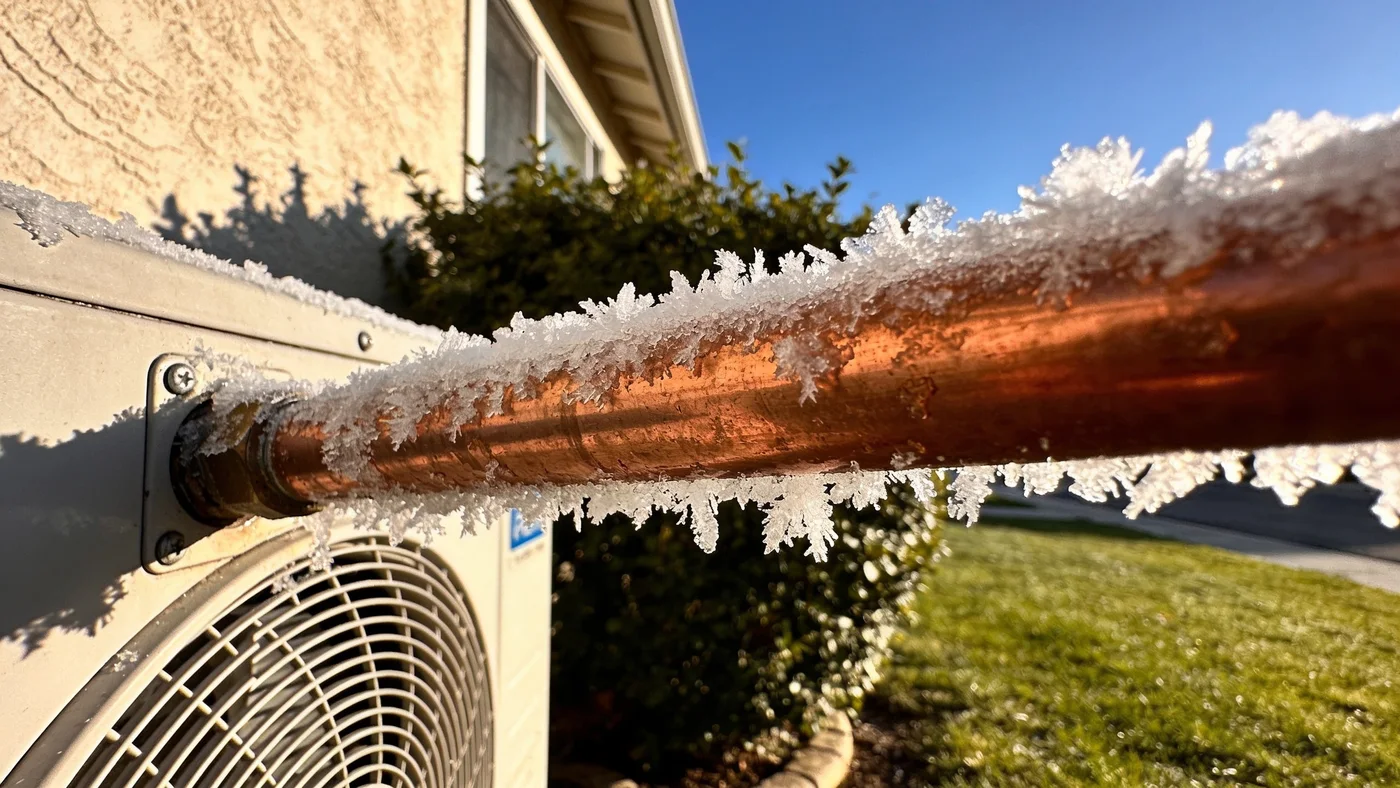
It sounds impossible: a 100-degree afternoon in Sacramento, and your air conditioner is coated in ice. Yet frozen ACs are one of the most common summer service calls we run.
The ice is not the problem. It is a symptom — and understanding it can save your compressor.
Why a hot-day freeze happens
Your AC cools the house by moving refrigerant through an indoor coil. That coil needs two things to work: steady airflow across it, and the right amount of refrigerant inside it. Take away either one, and the coil gets colder and colder until the moisture in the air freezes onto it.
The usual suspects, in order:
- A clogged air filter. The most common cause by far. No airflow, no heat reaching the coil, so it freezes.
- Low refrigerant. Usually means a leak somewhere in the system. The pressure drops, the coil runs too cold, and ice forms.
- A weak blower motor. The fan is running but not moving enough air.
- Blocked or closed vents. Too many closed registers choke the airflow the same way a dirty filter does.
- A dirty evaporator coil. Years of dust act like a blanket between the air and the coil.
What to do right now
- Switch cooling OFF, fan ON. At the thermostat, turn cooling off but set the fan to ON. Warm air moving across the coil melts the ice safely, usually within a few hours.
- Check the filter. If it is dirty, replace it before restarting.
- Open every vent. Give the system its full airflow back.
- Watch the drain. Melting ice means water. Make sure it is draining, not pooling.
- Restart and observe. Once the ice is fully gone, run cooling again. If ice returns within a day or two, stop and call — repeat freezing points to refrigerant or mechanical trouble.
Why you should not just keep running it
An iced coil returns liquid refrigerant toward the compressor — the heart of the system and its most expensive component. Running a frozen AC for days is how a filter problem becomes a compressor problem. Shutting cooling off early protects the part you least want to replace.
Keeping it from happening again
Every freeze has a cause. If a fresh filter and open vents solved it, you are done. If not, a certified technician should measure the refrigerant charge and inspect the coil and blower. Both checks are part of our AC tune-up, and ProCare members ($19.50/mo) get the spring tune-up included — which is exactly when freeze-causing problems get caught early.
AC icing up right now? Call Deal Mechanical at (916) 927-4500 or book an AC repair visit. We will find the cause, explain it plainly, and let you decide.